

When building a house, one of the biggest questions is always the roof. After all, it doesn’t just protect our home from the weather—it defines the entire building’s character, durability, and safety. If you’re about to start construction and haven’t yet heard about nail plate roof trusses, you’re in the right place—this article will help you understand why more and more people are choosing this modern solution.
What is a Nail Plate Roof Truss, and Why is it Special?
A nail plate roof truss is a structural solution where timber elements are connected using special toothed steel plates—called nail plates or truss plates. These plates aren’t fixed to the timber with screws or nails, but are pressed into the structural elements under high pressure, creating an extremely stable and strong connection.

This is what a Nail Plate looks like
What makes this technology truly special is that the roof structure isn’t built on-site. The elements are assembled in a manufacturing facility under controlled conditions. Before anything is built, a structural engineer designs the roof based on the construction plans—precisely calculating where the structure will bear loads and where the nail plates should be positioned.
The nail plates are always placed at nodal connection points—creating solid connections.
The timber is already surface-treated at the factory to make it more resistant to moisture, fungi, and insects. This means that when the roof arrives at the construction site, it’s already prepared and practically just needs to be assembled—like a giant, precisely designed puzzle.

photo by: TRUSS Design
Why is This Good for You as a Building Owner?
If you’re not an architect or structural engineer, it’s completely natural that the world of roof structures seems complicated at first. But nail plate roof trusses are a good choice precisely because they take the burden of design and construction off your shoulders.
- Faster construction: Since the roof elements are prefabricated, on-site assembly is much quicker. Thanks to the pre-made elements, the complete roof structure can be assembled in just 2-3 days.
- Fewer opportunities for error: Factory production is precise and controlled, independent of weather or site conditions.
- Cost-effective: Less labour, no waste, optimised material usage.
- Strong and durable: Nail plate connections have high load-bearing capacity, making them safe in the long term.
- More sustainable: The timber arrives precisely cut to size and surface-treated, so there’s no waste.
Where Are Nail Plate Roofs Used?
This technology works well not only for family homes but also for industrial halls and agricultural buildings. Due to the large spans, spaces can be created where internal support columns aren’t needed.
When using nail plate roof structures, there’s no need for a solid floor deck, as the floor plane will be formed by the lower plane of the roof structure. A thick PVC membrane—sometimes in two layers—is fixed to the lower plane, onto which double-layer plasterboard is attached. This essentially becomes the underside of the floor deck.
How Can a Nail Plate Roof Be Insulated?
Insulating a nail plate roof is just as important as with any other roof structure—after all, nobody wants to shiver in winter or swelter in summer in their living room. The good news is that this type of roof insulates excellently; you just need to know how.
Since the roof structure is prefabricated, insulation is usually installed after on-site assembly, from the inside. The most commonly used insulation materials are:
- Glass wool or rock wool: Good insulation, fire-resistant, and easily fitted between timber elements.
- PUR or PIR foam: These rigid foam boards are excellent insulators and effective even in thinner layers.
- Cellulose insulation: An environmentally friendly solution, also available in blow-in form.
The insulation layer is usually placed on the internal side of the roof structure; the nail plates don’t need separate covering. The insulation should be 15-20 cm thick.
What Covering Can Be Used for Nail Plate Roofs?
The nail plate roof structure is compatible with almost any covering material, so the building owner can freely choose according to aesthetics and functionality. The most common roof coverings are:
- Tiles (ceramic or concrete): Classic appearance, long lifespan.
- Metal sheeting (e.g., corrugated sheet, standing seam): Modern, lightweight, quick to install.
- Bituminous shingles: Lightweight, flexible, applicable even on lower-pitched roofs—but requires full boarding or OSB panel covering following technical regulations.
When choosing, it’s worth considering the roof pitch, the building’s style, and weather conditions. The nail plate structure provides a stable base, so the covering comes down to creativity and practicality.
It shouldn’t be overlooked that for gently pitched roofs (12-15 degrees), solid floor deck construction is also necessary, which brings significant cost increases.
What Should You Pay Attention To?
Although nail plate roofs have many advantages, there are a few things worth noting:
- Reliable manufacturer: Only work with a company that has experience and appropriate qualifications.
- Structural design: The roof’s safety depends on engineering calculations—this isn’t something that can be done “by feel.”
- On-site assembly: Though quick, it’s important that it’s done professionally.
- Roofing materials: Choose the covering that suits your needs for the nail plate structure.
What Happens if the Wrong Tradesperson Assembles the Roof?
1. On-Site Assembly Error in Nail Plate Roof Structure
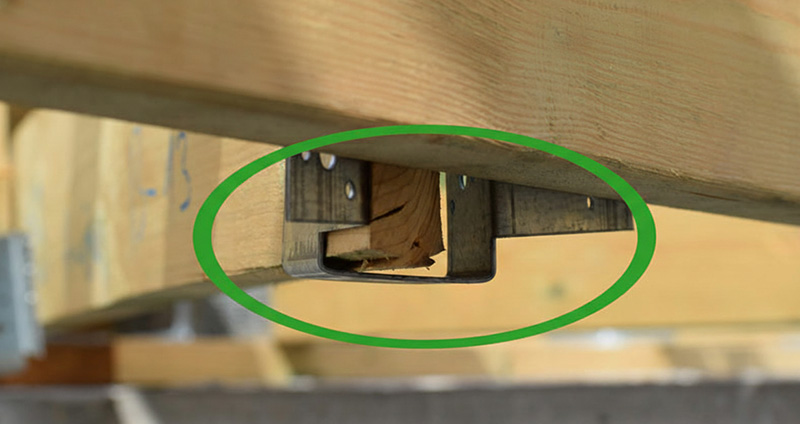
The roof structure elements were precisely and structurally correctly formed at the factory; however, a serious construction error occurred during on-site assembly. The roof elements didn’t fit together properly, creating a gap at the connection. This problem was attempted to be corrected with an inserted timber wedge, which is not only structurally questionable but can also lead to serious structural problems long-term. The structure became statically uncertain and unstable. The error clearly stems from unprofessional on-site work and illustrates well that manufacturing precision alone isn’t enough—construction quality is equally decisive.

Ensure wedge-free structural closure
2. Unjustified and Oversized Screwing in Nail Plate Roof Structure
At the roof structure node shown in the image, the fitting elements were fixed with large screws, seemingly without any structural justification. The screws don’t fit the logic of the nail plate system and don’t follow structural design principles. Such oversized and random fixings are not only aesthetically objectionable but can also be structurally problematic: they can cause stress concentration, weaken timber elements, and result in long-term instability. The error clearly indicates unprofessional work during on-site construction, rather than manufacturing design.

Must be secured with double-sided hinges or self-tapping screws
3. Inaccurate Fitting and Unprofessional Subsequent Repair in Roof Structure
At the roof structure node shown in the image, the battens don’t fit together properly, clearly indicating an on-site assembly error. During manufacturing, the elements were precisely formed; however, assembly according to specifications didn’t occur during construction. The resulting gap was later “filled” unprofessionally with a nailed-on patch, which is neither statically nor aesthetically acceptable. Such solutions not only reduce the structure’s load-bearing capacity but can also lead to cracks, deformation, and even accident risk long-term.

4. Fitting Error Due to Incorrect Angle Installation
At the roof structure node shown in the image, the batten wasn’t installed at the correct angle, resulting in joints not meeting precisely. This isn’t just an aesthetic problem but can also pose a serious structural risk, as load distribution doesn’t occur as specified. Nail plate systems require precise fitting, and angle deviation can weaken, deform, or even cause the structure to shift over time. The error clearly stems from carelessness or lack of expertise during on-site construction and shows well that manufacturing precision must be maintained during on-site work. Such inaccuracy or fitting errors mean the ceiling plane cannot be ensured. It mustn’t be overlooked that nailing joints cannot provide a solid and durable connection. Instead of nailing, bolted connections with wide washers that go completely through must be used alongside nail plate connections.

5. Stress-Related Crack in Timber Element—Missing Strapping
The timber element shown in the image came under stress due to incorrect fitting, leading to cracking in the timber. The crack clearly stems from mechanical loading during assembly and doesn’t indicate a manufacturing fault. In such cases, proper strapping—such as using steel straps or reinforcing plates—could have prevented the damage and also provided subsequent reinforcement. The error illustrates well that with nail plate roof structures, not only fitting precision but also assembly technique is crucial for the structure’s durability and safety.

6. Unstable Tightening Due to Improper Fitting
The roof structure elements shown in the image don’t fit together precisely, and the resulting gap was attempted to be corrected with a subsequent tightening. The applied solution doesn’t provide adequate structural connection, as the element ends still don’t meet, so load transfer doesn’t occur as specified. Such unstable fixings not only endanger the structure’s durability but also pose a serious safety risk. The error again indicates unprofessional on-site construction and shows well that nail plate systems require precision and expertise during assembly too.

7. “Good Enough” Mentality Assembly—Traces of Sloppy Construction
At the roof structure node shown in the image, sloppy, “good enough” mentality construction is clearly evident. Elements don’t fit precisely, fixings are random, and don’t meet expectations from either structural or aesthetic perspectives. This attitude not only endangers the structure’s safety but can also generate serious costs long-term for repairs and reinforcements. Nail plate roof structures require precise design and careful assembly—a “this will do” mentality is incompatible with durable and reliable construction.
Subsequent reinforcements or modifications involve dismantling the roof structure, which results in significant cost increases and heightens the risk of water ingress.
8. Notching in the Hip Rafter
What’s visible in the image?
- Another element (likely a common rafter or brace) is notched into the hip rafter, meaning a piece was cut from the hip rafter’s cross-section to make it fit.
- This notch weakens the hip rafter’s structural integrity, especially where loading is greatest.
- In nail plate roof structures, this type of intervention isn’t permitted, as nail plates and factory designs are based on precisely calculated force distribution.
Why is this a problem?
- The hip rafter is one of the highest-loaded elements in the roof structure, especially at corners where forces arrive from multiple directions.
- The notch interrupts the fibres, reduces load-bearing capacity, and can lead to cracking or deformation.
- If the design doesn’t include this solution, it qualifies as irregular construction that must be corrected urgently.
What should be done?
- The error must be reported immediately to the responsible technical manager and site inspector for both contractor and client, and recorded in the construction diary.
- The structure must either be reinforced (e.g., with steel plate, extension, support) or the affected element replaced according to designer specifications.
- The repair method must be coordinated with a structural engineer or designer, as it can affect the entire roof structure’s stability.
Tip: If you’re building a nail plate roof, always request factory plans and assembly instructions, and insist that construction follows specifications. Such seemingly minor modifications can cause serious problems long-term.

Error Summary—Lessons from Nail Plate Roof Structure Construction
Nail plate roof structures are based on precise engineering design, where every joint, screw, and plate is part of a carefully calculated system. However, the precision achieved during manufacturing is worthless if errors slip into the process during on-site construction. Based on the examples shown, the following errors are particularly common:
- Inaccurate fittings: Timber elements don’t meet, leading to structural weakening and instability.
- Unprofessional subsequent repairs: Timber wedges, patches, tightenings—these don’t replace proper structural connections.
- Unjustified screwing: Oversized or poorly placed screws can cause stress and weaken timber.
- Incorrect angle installation: Elements placed at improper angles disrupt load transfer and can cause long-term deformation.
- Stress-related cracks: Improper fitting or forced assembly can cause timber to crack—without strapping, this can worsen.
- “Good enough” mentality: Sloppy attitude isn’t just an aesthetic issue—it can have life-threatening consequences.
These errors aren’t merely technical problems but questions of moral and professional responsibility. A roof structure isn’t built just from materials—but from trust. The contractor is responsible for ensuring that what they deliver doesn’t just stand but keeps people safe.
Summary: A Roof That Takes Care of You
A nail plate roof is like a well-designed coat for your home: it fits precisely, is strong, and protects what’s most important long-term—you and your family. If you’re looking for a solution that’s not only modern but also reliable, it’s worth considering.
And don’t worry, you don’t need to understand statics or timber materials. It’s enough to know what you want and work with professionals who handle the rest. And the nail plate roof will be there above you—quietly, stably, unobtrusively, but securely.
_______________________________________________________________________________
If you have any questions, write to us! Discover more tips and ideas on our Pinterest page