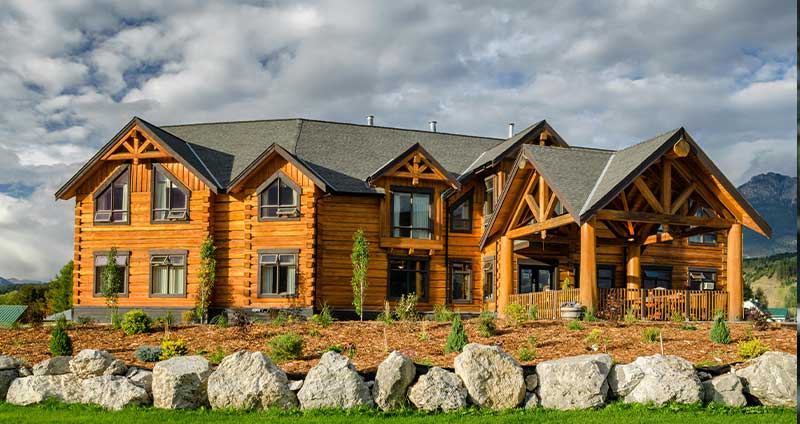
The timeless beauty and nature-inspired atmosphere of log houses make many hearts beat faster. Yet in recent years, fewer and fewer people are embarking on this type of construction. Instead, many choose lightweight or brick houses, which are completed faster and, at first glance, seem simpler to renovate.
However, a well-built log house is not only beautiful and unique but can remain habitable for up to 100 years—serving generations if we pay attention to the details. This article is for those who want to build not just a house, but a real home, a long-term value.
Wood Doesn’t Lie – But It Doesn’t Forget Either
During log house construction, one of the most important principles is the quality of the wood. Log houses can be made from coniferous woods, oak, and beech—the key word here is dryness.
Freshly cut, wet wood is easier to work with, but in the long term it can cause serious problems. As it dries, the wood warps, cracks, and the entire structure can become distorted. Such a defect is not just an aesthetic problem—after a while, the house becomes uninhabitable.
What Moisture Content Is Ideal?
The moisture content of wood used for construction should generally not exceed 18-20%. Wood with higher moisture content continues to work after installation, resulting in significant shrinkage and cracking. Professionally dried wood with approximately 15% moisture content is already stable and minimizes the risk of subsequent distortion.
In an earlier project, we encountered a case where the contractor built the house from freshly cut pine because “it was cheaper anyway.” Two years later, such gaps formed between the logs that the winter wind blew freely into the house. The entire structure had to be resealed, which was more expensive than if they had used properly dried wood from the beginning.
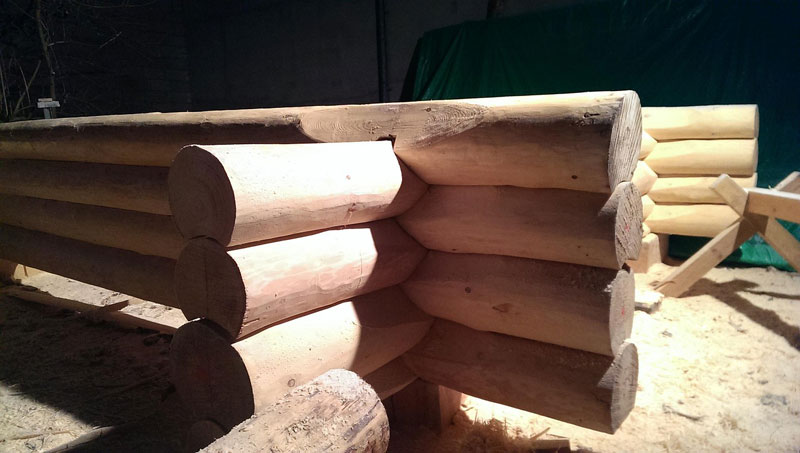
This is why professional preparation of the wood and chemical treatment before installation are essential.
The log house itself is manufactured at the contractor’s facility based on the approved execution plan, the wood is chemically treated—flame and fungus protection—and assembled, then after completion it is disassembled and reassembled at the construction site.
Fungus, Mold, Weeping – When Wood “Bursts Into Tears”
Many people think that log houses only need to be varnished or painted. But it matters what and how this is done!
Improperly treated wood quickly becomes a victim of wet rot fungus and mold, and can be completely destroyed. This is not just an aesthetic flaw but also poses a serious health risk. Wet rot fungus is particularly insidious: initially barely noticeable, but it spreads at a rapid pace and can destroy the wooden structure.

The Solution?
– Use wood preservatives that penetrate deeply and do not block the wood’s ventilation.
– Choose a surface treatment that is both water-repellent and breathable. This way the wood won’t rot, but gets the proper protection. Surface treatment should be applied by brush, not by spraying, as this is the only way to ensure that the material actually penetrates. With spraying, we can only apply a micro-layer to the surface, while with a brush we literally “rub in” the surface treatment material—achieving penetration of several millimeters thickness.
– The wood should be impregnated in two to three layers: the first layer with deep impregnation primer, followed by the coloring and protective layer.
Visiting a family in Transylvania, we saw with our own eyes how beautifully a 60-year-old log house maintained its condition when regularly maintained. According to the owner, they inspect the walls once a year and renew the protective layer where necessary. Thanks to this, the house today looks as if it was built yesterday.
What Should We Pay Attention to During Planning?
The key to cost-effectiveness doesn’t begin when we try to save on the last screw. But already during planning.
We can gain a lot even on small details that don’t seem important at first:
– Unnecessary corridors, hallways, overly decorated elements—these not only make construction more expensive but also reduce usability. In a 120 m² log house, a 15 m² hallway is simply wasteful.
– Don’t just look at prices in a contractor’s quote! A price that’s too cheap is suspicious. The lack of quality comes back later, and the seemingly cheap house becomes a very expensive learning experience.
– The orientation and placement of the house is not negligible either. A south-facing living room with large windows heats the house for free in winter, and in summer it can be shaded with proper eaves projection.
Building Regulations
During log house construction, we must naturally take into account the applicable building regulations. According to current EU regulations:
Energy Performance Requirements: New residential buildings must comply with the Energy Performance of Buildings Directive (EPBD 2010/31/EU, revised 2018/844/EU). For log houses, this generally means proper thermal insulation of the attic floor and windows. The EU’s nearly Zero-Energy Building (nZEB) standards require high energy efficiency, though specific requirements vary by member state.
Fire Safety Requirements: Fire protection treatment of wooden structures is mandatory, especially in residential areas. Fire-retardant impregnation slows flame spread. Log houses must meet Euroclass fire ratings (typically Class D-s2, d0 or better for structural elements).
Structural Requirements: Log house structures must also meet static requirements, including snow load and wind load resistance according to Eurocodes (EN 1990-1999 series).
Building Permit: A building permit is required for log house construction—specific thresholds vary by country, but generally buildings over 50-100 m² or permanent residential structures require permits. Always check local and national regulations.
Where We Should Never Skimp
There are points during construction where we simply cannot compromise. These include:
Planning – The Soul of the House
A well-thought-out architectural and mechanical plan is the basis for long-term return. Everything is decided here: the orientation of the house, the efficiency of the heating system, the level of energy consumption.
A well-designed solar collector or heat pump system, for example, saves a considerable amount on utility bills—month after month. A floor plan developed together with a careful planner determines for decades how functional and comfortable our home will be.
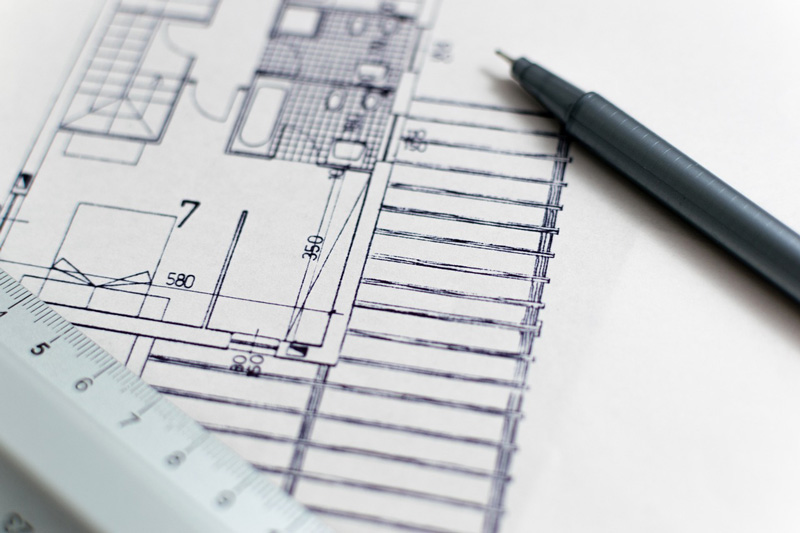
One acquaintance’s family, for example, designed their 90 m² log house so that the open living-dining-kitchen unit forms the heart of the house, while the bedrooms are separated in a quiet wing. This solution minimized circulation space, and every square meter became useful.
Foundation – The Foundation Is the Foundation
Log houses also require proper foundations. Although lighter than brick houses, we must consider the soil’s bearing capacity and the frost line. Pier foundations or strip foundations are most common, but all of this is held together by a reinforced slab foundation.
It’s important that the foundation is made with proper horizontal waterproofing so that ground moisture cannot reach the wooden structure. The log house is placed on this horizontal surface.
Insulation – Because Heat Doesn’t Stay Inside by Itself
Many people think that log houses don’t need insulation. Partly true: the mass and thickness of logs indeed have excellent thermal insulation properties. A 20-25 cm thick log wall’s thermal transmittance coefficient already approaches standard requirements.
But! The area around windows and doors, the attic floor, the roof—these are not so fortunate. Insulation is necessary here, and properly executed.
The gaps between logs are usually sealed with hemp, flax, or jute filling, which must be resealed later—after the house settles. This is a living structure that works together with the wood’s movement.
Choosing the Contractor – Don’t Trust Blindly!
Building a log house is not an everyday project. Here we need a contractor who understands the nature of wood, knows how the material behaves over the years, and has experience in building a lasting home from it.
Let’s look at their previous work, ask for references, talk to those who already live in the houses they built. These few hours of research can ensure our peace of mind for years.
A friend worked with a contractor who had previously built three log houses in the area. He personally visited all three owners and asked them about their experiences. This small preparation gave enormous peace of mind during construction, and every promise was kept.
How Much Does Building a Log House Cost?
Costs naturally depend on many factors: the size of the house, the quality of usable wood, interior equipment, and regional price differences. Generally speaking, the price per square meter of a turnkey log house ranges between €1,300-€2,000, meaning for a 100 m² family home we should expect around €130,000-€200,000.
Of course, there are cheaper solutions, especially if we buy a prefabricated house or do certain work ourselves—interior work or surface treatment work. Structural work must only be done by professionals. But in the interest of quality and durability, it’s worth planning realistically.
Note: Prices vary significantly across EU member states. In Western Europe (Germany, Austria, France), expect the higher end of this range or above. In Central and Eastern Europe, prices may be at the lower end. Always obtain local quotes.
Maintenance – The Secret to a Long Life
A log house is not “maintenance-free,” but if we pay regular attention to it, it can serve for generations.
What’s Worth Doing Annually?
– Visual inspection: Look over the walls, look for cracks, gaps.
– Seal inspection: The sealing between logs compacts over time, may fall out. Supplement where necessary.
– Paint, impregnation: Every 3-5 years, re-treatment of exterior surfaces is recommended, especially on the south, sun-exposed sides.
– Gutters, drains: Keep them clean so water doesn’t reach the walls.
Summary: The Log House Is Eternal If We Do It Right
The log house is not for everyone—but for those looking for a real home, longing for a nature-oriented lifestyle, and not afraid to delve into the details, it can be a real treasure.
This construction form is not only tradition-preserving but also environmentally friendly, and when implemented with proper expertise, it serves its residents for many decades. Wood is a natural material that breathes, regulates humidity, and creates a pleasant microclimate in the home.
The question, therefore, is not whether log houses can still be built in the 21st century. But whether we can approach it consciously and responsibly enough? If the answer is yes, then a log house will not only be a home but a lifelong investment—both emotionally and financially.
Regarding where and under what conditions we can build a log house, we must always consult national and local building regulations under all circumstances. (Urban or farm or forest area, etc.)
Discover more tips and ideas on our Pinterest page